Sunday, March 16, 2014

Circuits


This past week in Science Honors, we were introduced to the world of circuitry. For me, this week felt like learning a new language: current, resistance, potential, Ohm's law, diodes, transistors, and voltage regulators...what?! Luckily, we used our class time to experiment and have some fun completing labs. Because our balloon project will require circuitry, this unit in class is super important for our balloon-launching-success! 
Let's take a look at some basic circuit-building vocab:

Diodes- current only travels one way through a diode; our diodes were LED. When current passes through them they light up. It was almost like playing with a Light-Brite!

The green light is a diode on one of our circuit boards.
Transistor- a gate controls the switch on a transistor. If the gate is closed, current will pass through; if it is open, current won't pass through. I think of it like an electric fence for cows: if you close the gate you'll get a shock if you touch the fence!

Transistor = small black square
Voltage Regulator- regulators are so useful in making circuits. What do you do if you have a 9 volt battery and want to light a diode that can only receive 5 volts? Use a voltage regulator! Just like their name they 'regulate voltage'; they can receive 9 volts in and send 5 volts out. They come in many different sizes: 5 volts, 15 volts, 30 volts, etc.

The voltage regulator is located in row E of our circuit board.
Resistor- resistors are used to regulate the flow of current by decreasing the amount of current. Resistors remind me of a traffic jam on the highway where only a small stream of cars get through.


The wires are connected to the resistors.A 'mini resistor' on our circuit board. The colors of the bands indicate how much resistance it has.

At the beginning of the week, the only experience I'd had with circuits was a 6th grade project when I made a merry-go-round that very slowly rotated. By Friday, however, I had helped design circuits, drawn up schematics, and assembled circuit boards. This semester has been filled with so many new learning experiences!

--Olivia

Wednesday, March 5, 2014

Hatching Fish

Last Thursday, we went to a fish hatchery. If you're like me, that means absolutely nothing. So let me explain...


Caledonia Fish Hatchery
The map above is the hatchery we went to (apparently the oldest one in the northern hemisphere). The point of a fish hatchery is to, well, hatch fish. Essentially, they raise fish from eggs to normal fish-size, and then release them somewhere, in the wild or otherwise. At the hatchery, they have the whole gamut of fish-sizes, from the size of your pinky to the size of your arm. So how do they raise them?

These bins feed the fish.
The little black boxes in the map above are pools of water, which is actually redirected from the stream right next to the facility. All the pools have fish in them that, interestingly, feed themselves. Staff fill up bins (see picture to the right) in the morning, with a specific amount of food, and the fish basically bump into a bar inside and knock food down (kinda like a cereal dispenser).

They only have a few workers at the hatchery, so the dispensers allow them to spend more time on other things and less time feeding fish.
It was pretty cold walking around, but it was still pretty interesting (I think that my feet almost froze off). I was personally amazed at how the fish were quite lively in the water, even though it was so cold; I'm not a Bio major, however, so this may be standard procedure.


Overall, it was a good time.

--Michael
I enjoyed this sign.

Friday, February 21, 2014

Mixing of (Ocean) Water

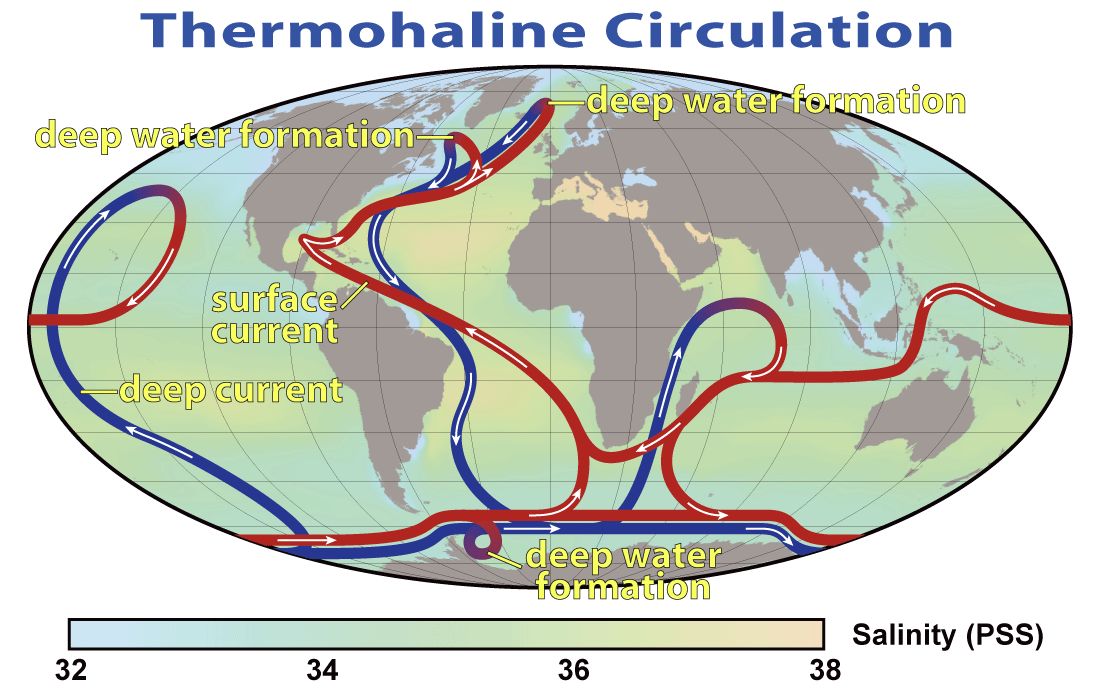
Today in our 8:00 am science honors class, we learned about the thermohaline (thermo:temperature and haline:salt content) circulation that occurs in the Earth's oceans. We were given the task to create 'the Atlantic Ocean' in a small plastic container. To create the thermohaline circulation in the Atlantic Ocean (which is due to density differences in different parts of the ocean), we needed the dense water from the pole to sink and flow towards the equator, the water at the equator to stay on the surface and flow towards the pole, and intermediate water to stay in the middle.


Courtesy Wikipedia

The materials that we had to work with included: water, hot plates, dye, salt, ice/snow, and cardboard. We were given 45 minutes to create our mini ocean masterpieces.

First, we created three solutions of water: cold salty polar water (blue), hot equator water (red), and temperate water (yellow). We filled one side of our container with snow to represent the glaciers at the pole, and one side of the container was placed next to a hot plate to simulate the warming at the equator. Finally, we filled the container with the temperate water, added the hot water at the 'equator', added the cold salty water at the 'pole', and watched the circulation occur!

--Olivia and Michael

Take a look at our video:

Saturday, February 15, 2014

Team Lineup

This is the team lineup. Note that the questions we are trying to answer are subject to change.
Russel


Team Members:

Team Sparkles

Dan Hammers
Dan Schulz
Ruthanna Wantz
Balloon Name
Russell
Question to Answer:
How does the amount of ultraviolet radiation absorbed by ozone affect temperatures in the stratosphere?
Our Hypothesis:
We expect that the amount of ultraviolet radiation detected will increase with altitude, and temperature will increase accordingly.


Dug


Team Members: 
The Flying Monkeys

Andrew Redman
Ronald (Bub) Duttweiler
April Peterson
Sarah Kopa 
Balloon Name
Dug
Question to Answer:
How much infrared light is absorbed by the atmosphere at each altitude?
Our Hypothesis:
We believe that more infrared light will be absorbed at the top of the atmosphere.  As our balloon rises, we hope to see more infrared light in proportion to visible light.


Kevin


Team Members:

Team Maple Leaf

Michael Ganger
Olivia Morse
Kayla Miller
Jordan Scott
Balloon Name
Kevin
Question to Answer:
How does the concentration of CO2 change as altitude increases?
Our Hypothesis:
Compared to other gases in the air (N2, O2, etc.), we expect that CO2 will be less concentrated farther up into the atmosphere.

Put simply, the percentage of CO2 will be less at high altitudes.

Tuesday, February 11, 2014

Cuba Lake: Not the tropical island

Recently the high temperature in Houghton has been 20°F. While most students have been hiding inside their warm dorm room drinking hot chocolate, the science honors students are always up for an adventure. During Monday's lab we (minus Andrew and Sarah who were sick) drove to Cuba Lake to take some water samples. First Dr. Wolfe showed us how to drill the hole through the 12 inch thick ice using the ice drill. 
Fun fact of the day: You need around 4 inches of ice for walking, 8 inches to support a small car, and 12 for a larger truck. 
A thermometer was lowered meter by meter to find the temperature of the water with depth. We used a capsule with a weight attached (called a Kemmerer water sampler) to collect water samples at various depths. With frozen hands we managed to take the pH of each sample and bag it for concentration readings on Thursday.


This data will help us to determine if it is a eutrophic or oligotrophic lake. Eutrophic lakes contain a large amount of nutrients that support plant and algae growth while oligotrophic have little to almost no nutrients. The clearer the water, the more oligotrophic. The oxygen meter was not working properly but after being there for an almost an hour we decided to leave before we got frost bite. At the end of the day we were all very thankful for wool socks and warm mittens.


Thanks to Michael's backpacking GPS we were able to track our exact location:


-Kayla

Sunday, February 9, 2014

Dodgeball

"Hey! Who wants to play dodgeball? I signed science honors up to play in the tournament on Friday!" This was the conversation that began our western civilization class last week. Soon, we were all on board. Our eight player team would consist of: Bub, Michael, Andrew, Dan, Ruthanna, Kayla, Olivia, and April.

We decided then and there that science honors would dominate the competition with our dodging ability. Who could possibly beat the forces that our team would bring?

Full of team spirit, we arrived at the tournament and began our stretches. We sat in the bleachers together as the rules of the game were explained (there were a lot!). Soon, the first match-ups were announced, "Science honors will be playing the baseball team on court A." We looked around at each other in disbelief as we faced the toughest team in the competition.

Our fans cheered as we entered the court, and the game quickly began. After a few minutes of incredible dodges, throws, and ninja moves, our team was defeated. Three more intense rounds of dodgeball were played by our science honors team resulting in one win throughout the night. Overall, the dodgeball tournament was a fun experience for our team as we dodged, danced, and laughed together!

-Olivia


Friday, February 7, 2014

Radiosonde Project - Overview


So, what exactly is this "Balloon 2014" thing all about? Seems obscure. Probably irrelevant. And what in the world is a radiosonde?

Hopefully, this post will enlighten you. Read on to find out.

Overview

The Houghton College Science Honors group, hereafter referred to as "Science Honors," intends to collect data from the atmosphere, analyze the data, and draw conclusions. So, what does this actually mean?

You've probably never heard of a radiosonde, however you probably know what a weather balloon is.

Well radiosonde is really just a fancy scientific term for the part of the weather balloon that does all the work. The radiosonde takes all of the measurements, stores it all as data, and sends it back to the scientists on the ground.

A few years ago it would have been impossible for anyone but climate scientists and weather stations to build a weather balloon, however the price of parts has become cheap enough that it is feasible to build one on a relatively small budget.


Picture Selectively to Scale.
The relative altitudes of Mt. Everest, airplanes, and weather balloons. 


Collect Data
This is done using a weather balloon. Though it won't carry people like a hot air balloon, it will certainly do more than a party balloon. Sensors will take measurements about temperature, pressure, and the amount of visible light. 

Analyze the Data
The balloons will return "raw" data. These data correspond directly to readings from the sensors, not actual conditions. We need to look at the raw data and convert the numbers we receive from the sensor into real data which has significance. 

Draw Conclusions
Obviously, if you're going to collect data, you want to use it for something. We will use the data to either prove or disprove our original theories. When we have a more definite view of what we will be measuring we will make another post describing our hypotheses.

Picture credit to NOAA
Requirements
Physical Balloon
The balloons will be traveling high into the atmosphere. We hope that they will be able to reach the stratosphere, nearly 20 km above the ground! 

Electronics
The balloon will be run by a small computer, called an Aruduino, which will need to be wired with sensors to take readings. An Arduino is not a very powerful computer, however it is small enough to fit in the palm of your hand, and runs on very little power.
Arduino Uno Microcontroller


Programming
The balloons will be programmed to continually take measurements. These measurements will then be saved on the balloon so they can be downloaded after it is retrieved, as well as wirelessly transmitted in case the balloon is lost.

We have begun working on a protocol to transmit the data back to our computers on the ground. If you're interested, take a look at our last blog post that explains this in more detail. 

--Andrew, Michael, Kayla, Dan, Olivia